
The "Servants' Door"

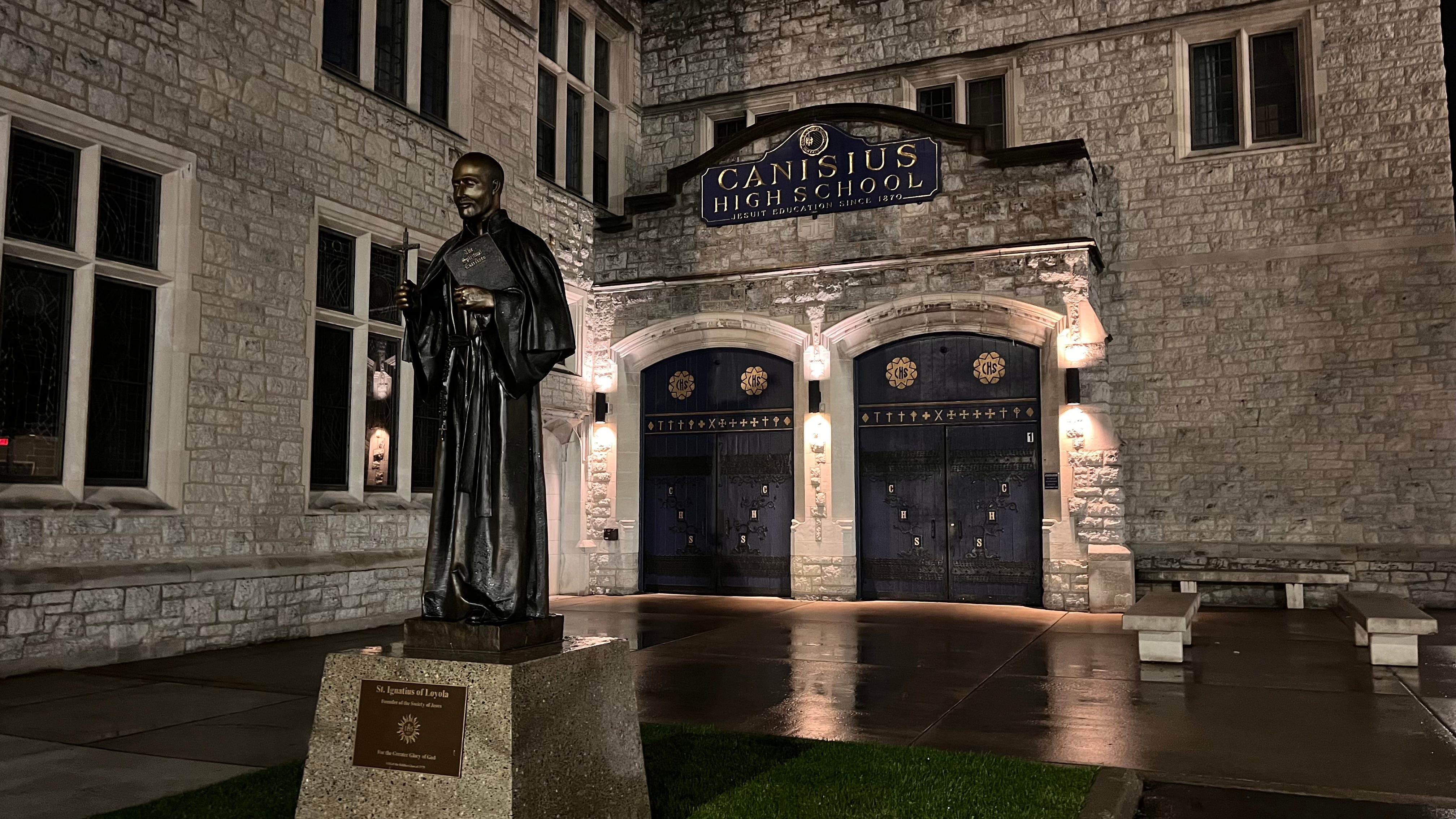
Canisius High School has a famous set of “Big Blue Doors.” They’re a signature part of the campus, and have served as the daily portal to learning for generations of students. The first day of freshman year is marked with a ceremonial passage through them. They’ve been referenced in many a commencement speech, and loom large in the school’s mythos (even though, many are surprised to learn, they haven’t always been blue). By now, they’ve become part of its ethos, too. I have some familiarity with them—probably more than most alumni—literally having written the book on the place. The title? Blue Doors.
Fifty or so feet to the southeast, you’ll find another door. It’s a little less striking but equally impressive in a subtler way, set in a curved turret and bearing all the hallmarks of a medieval castle entrance. It isn’t used as often, but when it is, it tends to be for special events. It makes a good backdrop for photos if you’re looking for something a little different from the Blue Doors, or if you’ve had enough blue for a change.
A little to the north of the Blue Doors, you’ll find the shiny glass doors of the relatively new field house. This is the athletics entrance. It’s used by early-arriving teams for their morning practices, and is a hub of activity around basketball games, school dances, and the like. Arguably, these are more functional than legendary, at least for now. They haven’t been around long enough to take on any mythic status in their own right. Of course, they will over time.
In front of the place, on Delaware Avenue, you’ll find the original main entrance to the Rand Mansion, marked with an often-unnoticed wrought-iron “R.” These glass doors are the public-facing entrance to the school, and lead to the reception area. It’s also through these glass doors that each graduating class exits the building following Commencement each year, marking a symbolic point of departure that complements the Blue Doors’ association with arrival.
But then, situated between the stylish turret entrance and the unmissable “Big Blue Doors,” you’ll find what I call the “Small Gray Door.” There is nothing special about the Small Gray Door—at least not in terms of appearance or style. In fact, it wouldn’t surprise me if many students and parents don’t even notice it day-to-day. It’s the access point least used by students. Back when the Rand Mansion was the Rand Mansion, this was the “servants’ entrance.” Fittingly, this is the door most used by the faculty, staff, and administration…those of us for whom the school is a workplace as much as a vocational wellspring.
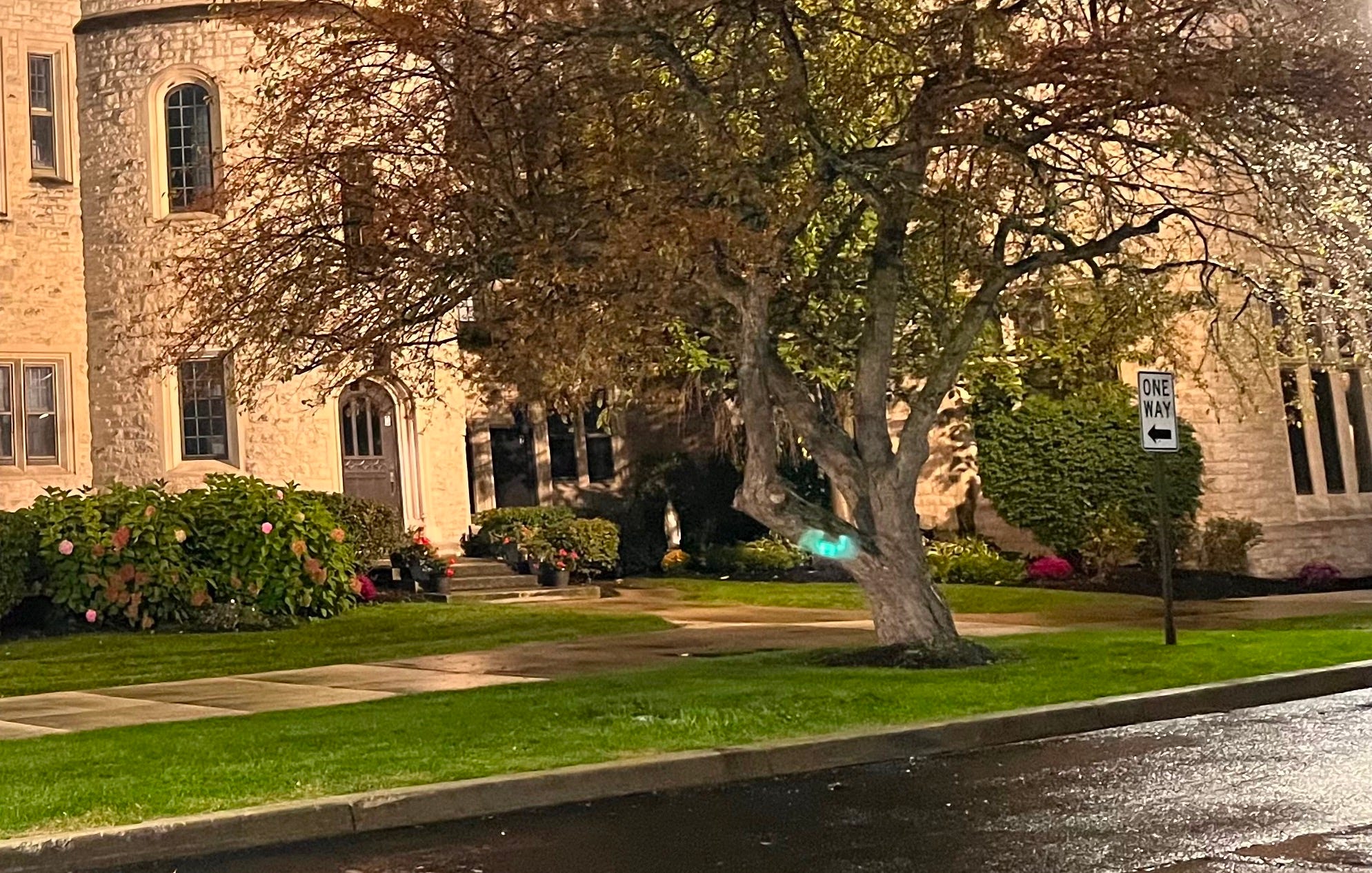
That duality is represented well by this understated, humble, wholly functional portal. There’s nothing flashy about it. It leads you into a tiny vestibule containing a maintenance closet and nondescript stairwell, with utility stairs heading down to the maintenance area and up—via an uncomfortably tight squared-off winding climb—to offices and the attic. If you continue straight, you enter immediately into the beautiful mansion corridor and its gleaming hardwood floors.
I could riff on the metaphoric significance at some length, but I don’t think it’s necessary. You get the point: The teachers and staff use the servants’ entrance to begin each day of a vocation oriented around Christ-centered servant leadership. As an alumnus, I have keen memories of the Blue Doors, of course. And I still use them from time to time—sometimes for convenience; sometimes for nostalgia. But when I think about going to Canisius High School at this point in my career, it’s the Small Gray Door that comes to mind first. I imagine it’s the same for the lot of us who work in the educational trenches, from the newest teachers through the faculty and staff and administrative ranks, all the way up to the President.
What is worth pointing out is that on our daily trek from the parking lot to the Small Gray Door, we pass two notable features. The first is a beautiful tree that endures the long months of winter just like we do, then builds slowly to a remarkable aromatic bloom that celebrates the final stretch of classes each year. The second, which we can’t help but notice as we fumble for our ID cards to unlock the door, is a statue of the Blessed Mother. On the darkest winter mornings, she seems to be there just for us.
As I look forward to year 25 in the classroom, I can’t help but realize that—God willing—I’m probably past the halfway point of my teaching journey, at least in the traditional sense. When I think ahead to what it will be like after retirement someday, I have to imagine I’ll remember many of the big moments. But I’d like to think that I’ll share a memory in common with colleagues past, present, and future: stepping through a plain, ordinary door to begin another day of beautiful, extraordinary work together.
What a gift.
Loved this reflection. Thanks for sharing.